
What do the words “Mormon” and “Cumorah” mean?

Question
Dear Gramps,
Curiousity question: Did Joseph or any other church leader ever say what the words “Mormon” or “Cumorah” mean?
Jen
Answer
Dear Jen,
I know of no writing that gives the etymology or defines either the word Mormon or Cumorah. Although proper nouns generally derive from some source, there is nothing known about the language of the Book of Mormon people other than that which is written in the Book of Mormon itself. However, I can give you a reference that authoritatively declares what the word Mormon does not mean. These are the words of Joseph Smith, the Mormon prophet, who, by the gift and power of God, translated the Book of Mormon from its original Egyptian text into English.
Sir:–Through the medium of your paper, I wish to correct an error among men that profess to be learned, liberal and wise; and I do it the more cheerfully, because I hope sober-thinking and sound-reasoning people will sooner listen to the voice of truth, than be led astray by the vain pretensions of the self-wise. The error I speak of, is the definition of the word “Mormon.” It has been stated that this word was derived from the Greek word mormo. This is not the case. There was no Greek or Latin upon the plates from which I, through the grace of God, translated the Book of Mormon. Let the language of that book speak for itself. On the 523d page, of the fourth edition, it reads: “And now behold we have written this record according to our knowledge in the characters, which are called among us the Reformed Egyptian, being handed down and altered by us, according to our manner of speech; and if our plates had been sufficiently large, we should have written in Hebrew: but the Hebrew hath been altered by us, also; and if we could have written in Hebrew, behold ye would have had no imperfection in our record, but the Lord knoweth the things which we have written, and also, that none other people knoweth our language; therefore he hath prepared means for the interpretation thereof.” (Times and Seasons 4:194)
Gramps


This is in no way authoritative, but it’s what I think:
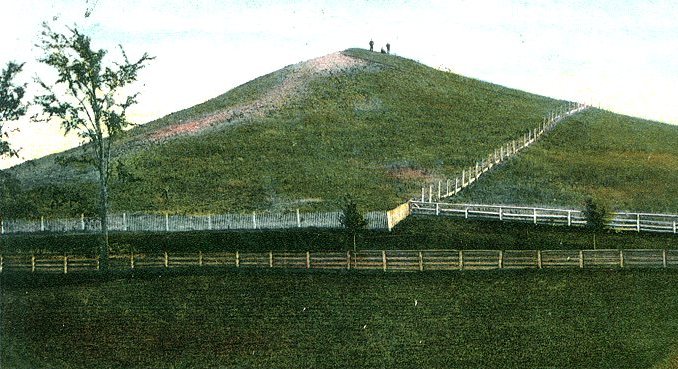
Cumorah – If the hill Cumorah where the great battles took place was the Cerro Vigia down in Mexico, and if Vigia is the spanish translation of the original ancient name of the hill, then Cumorah could possibly mean something like: ‘Place of the Overwatch’ or something similar. ‘Vigilar,’ in spanish means, ‘to watch over.’
It’s just a guess, of course, but it’s interesting.
Mormon – Brandt Gardner, in his commentary of the Book of Mormon, points out that Mormon was most likely named after the land of Mormon, where God restored the covenant with Alma the Elder. Therefore, the word Mormon might refer to the restoration of the covenant. The Book of Mormon might be: “The Book of the Restoration of the Covenant,” a very fitting title, given its purpose in these latter-days.
According to this institute manual page at ldsces.org, the word Mormon means “more good.”
Regarding the meaning of the name, “Mormon”, at the conclusion of the above letter in the Times and Seasons, Joseph Smith states:
” … say that ‘good’ is among the most important (terms) in use … we say from the Saxon, “good”; the Dane, “god”; the Goth, “goda”; the German, “gut”; the Dutch, “goed”; the Latin, “bonus”; the Greek, “kalos”; the Hebrew, “tob”; and the Egyption, “mon.” Hence, with the addition of “more,” or the contraction, “mor,” we have the word “mormon”; which means, literally, “more good.
Yours,
Joseph Smith.” From STPJS Pg 335
Concerning the meaning of “Cumorah,” there has been some study, and Paul Hoskisson on the FARMS website concludes with the following:
“In summary, there are several possible explanations for Cumorah. Two, namely a derivation from Gomorrah and a feminine form of kmr meaning “mound,” seem to work well, both from a linguistic standpoint and from etymological appropriateness. Two other proposals do not seem to work well, mainly for linguistic reasons. The last suggestion, “[Unacceptable] Priesthood Hill,” could work linguistically and, with a stretch of the imagination, might be explained appropriately.”